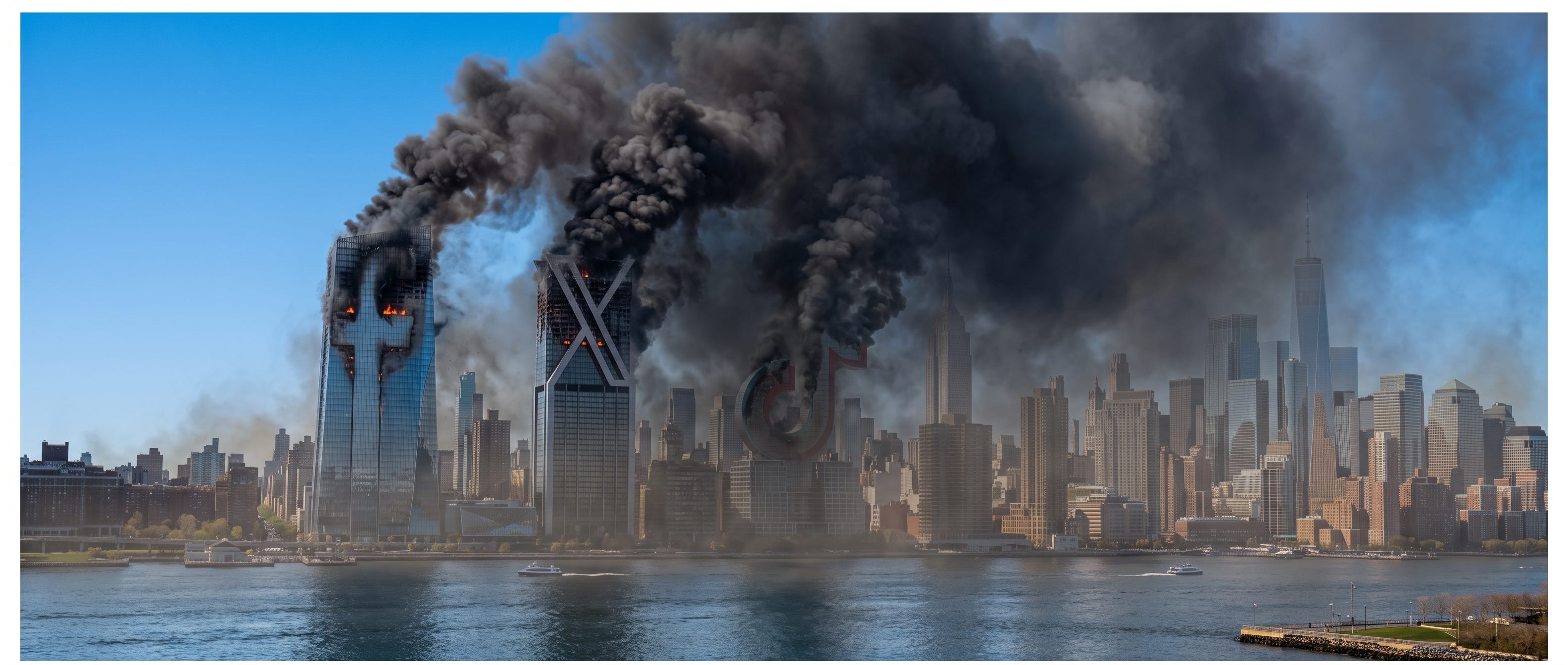
I started law school 26 years ago this month at Brooklyn Law School. I was a “second year” in September of 2001, deep into what we called “On Campus Recruiting” where large law firms would interview “on campus” to fill out their coveted “summer associate” classes for the following summer. On September 11, 2001, I walked to school, no doubt thinking about all the cool interviews I had lined up. Back then all the firms were lockstep, and no matter what firm you landed at, I expected to make about $2,200 per week for 10 weeks over the following summer, which was pretty cool for a basically unemployable 23-year-old non-lawyer.
When I left my apartment that morning, I saw the smoke from the South Tower and, as I walked to school, I heard the boom as a second plane hit the North Tower. I also saw a few fire trucks go by. Not really knowing what was happening, but knowing it was bad, I continued on my walk to school.
I watched the towers fall on the TV in the student lounge, and stood in line with ash-covered people waiting for a phone at the security desk in the law school lobby so I could call home and tell my parents I was fine. I remember I had a cell phone, but the lines were down. Then, not knowing what else to do, I went home. My roommates were processing the news by getting high on the couch together, watching the news. I did not get high, but I certainly stopped thinking about my $22,000 payday. The world had changed. Not a heroic or even interesting 9-11 story, but a lived history of a tragic day when the world changed.
A lot of people remember the unity and sense of purpose in the days after 9-11. There was some of that. I remember at least one impromptu candlelit vigil, and folks solemnly parading around with American flags. I remember the posters of the missing all over Brooklyn and Lower Manhattan. But I also remember getting into an argument with another law student about whether America deserved 9-11, and another classmate, a seemingly normal guy, who started to hang posters saying “9-11 Was An Inside Job.” I suppose everyone was trying to process the news in their own way.
As uninteresting as my 9-11 story is, what’s significant is that in the days after 9-11 we all had to talk to each other to make our point and process our grief. As my roommates could attest (and did), the bars in Brooklyn were full in the days after 9-11. People were talking to each other and trying to make sense of it, human to human. There were very few sad-faced emojis or digital stickers of cartoon cats expressing sadness and shock. And a precious few short-form videos where people expressed their outrage to their like-minded bubble. And there were no bots to promote conspiracy theories and create their own reality.
Perhaps that is why we remember the unity. Not really unity of opinion, but a unity of people who came together as a community to process or mourn, in public. While we process personal experiences, milestones and grief that way (hopefully), we don’t process public experiences, milestones and grief that way anymore. The country’s anemic Semiquincentennial celebrations are one sign of it. So is the fact that 1.2 million Americans died of COVID and there has been nary a public commemoration to process that monumental loss together.
What has taken the place of this public square? You guessed it: social media. 25 years ago there was no social media to shout our world view back at us. There was no Facebook (b. 2004), no Twitter, now X, (b. 2006), no Instagram (b. 2010), and no TikTok (b. 2016 in China as Douyin, 2017 everywhere else). And there were no smartphones to scroll any of it on, and there was no social media app to “feed” me “my” news.
I can’t help but reflect on these pre-social media days when I read about Meta’s settlement with the states, reported at somewhere between $17 billion and $18 billion depending on which outlet you read and which contingent payments you count. I’ve reviewed the actual settlement document here and it’s a really interesting structure: a $75 million Cost Fund Payment to reimburse the states’ investigation costs, and then the bulk of the money is in “Guaranteed Installment Payments” to each state, and “Contingency Installment Payments” that only pay out if certain conditions are met (more on that later). There is also injunctive relief: Meta has to impose a “night access mode” on teen accounts from 12 a.m. to 6 a.m., adopt an age assurance framework, restrict notifications, and limit daily use, though the specific hour caps reported in the press I have not independently verified against the document. Parents can override all of it, which, as any parent of a teenager knows, is not exactly a hard cap.
I called this two years ago. In v16 of this newsletter, I labeled the school district social media suits the “Tobacco Model” because they were structured exactly like the 1998 state suits against the cigarette companies (the 1998 Master Settlement Agreement, or “1998 MSA”). I’ll take the win on that one. But it’s worth being precise about where the two settlements actually match up and where they don’t, because in my opinion they diverge in almost exactly the wrong direction.
Both settlements exist because governments, not injured individuals, sued over the aggregate public cost of a product allegedly designed to hurt people. That’s not a technicality, it’s the whole reason either settlement was possible. A state doesn’t have to prove that any one smoker’s cancer, or any one teenager’s depression, was caused by the product rather than something else going on in that person’s life. It only has to show the product cost the public money at scale. Individual plaintiffs don’t get to do that, they need to show causation. I learned this years ago when I did personal injury work (I don’t anymore), and I had to engage in these massive causation fights over a client’s prior injuries. Was he really hurt because he fell, or was it the car accident he had as a teenager? That is also why hundreds of individual social media cases are still grinding through the litigation (called a “Multidistrict Litigation,” because similar cases from all over the country are centralized in one district (confusing, I know)). Those cases are untouched by this settlement. You can bet there are some very well-paid lawyers reviewing or fighting for the mental health records of numerous (dead) children who claim a social media injury. I hope those lawyers are well-paid for their souls.
Another similarity is that the settlement agreement is actually good for the defendants. How? One thing that has not gotten a lot of press is the “Industry-Wide Adoption” and “New SMP Entrant” provisions. Hat tip Legalnewsline for being one of the only publications to pick this up. Under the terms of the settlement, bigger contingent payments and the tighter “Phase II” limits only kick in if Snap, TikTok, and YouTube adopt equivalent restrictions within ten years, and Meta’s obligations shrink again if a new entrant with 5 million-plus U.S. teen users doesn’t play by the same rules. That is essentially a way that Meta is (1) pressuring the AGs to get the same relief from its competitors and, more importantly, (2) creating a barrier for any new social media entrant that it did not have as it experienced its explosive growth. The “New SMP Entrant” provision is probably worth $17 billion to Meta because it means that just when any other social media platform is getting going (5 million teenage users are not too many), the government is going to come after it and put restrictions on it. It’s going to make it a lot harder to launch a social media platform in the future. I’d say that Zuckerberg and his lawyers are brilliant, but then I realized that this is the tobacco playbook: the 1998 MSA did the same thing for cigarettes, it made it prohibitively expensive to enter the market because new entrants have to comply with all the restrictions that the rich incumbents agreed to. And the new entrants just can’t afford it.
One major difference is that there is no funding for any real public education effort about the pernicious effects of social media, especially on teenage minds. That’s not a small omission. The U.S. Surgeon General’s 2023 advisory on social media and youth mental health found that frequent social media use is associated with changes in the developing amygdala and prefrontal cortex, the regions that govern emotional regulation and impulse control, and can increase sensitivity to social reward and punishment during exactly the years, roughly ages 10 to 19, when kids are most susceptible to it. The 1998 MSA funded decades of anti-smoking public education, the campaigns responsible for making smoking look pathetic instead of cool (RIP, Joe Camel). There’s no equivalent line item here, and no requirement that Meta release internal documents the way the tobacco companies had to, the disclosure that fueled decades of follow-on litigation and regulation. And remember, nobody could ever legally sell a kid a cigarette in the first place; public education still did most of the work of making smoking uncool. Social media doesn’t even have that legal backstop, there’s no age at which using Instagram is illegal, which makes the case for public education stronger here, not weaker.
And, finally, there is the money. The 1998 MSA was worth more than $200 billion in 1998 dollars, over $400 billion today, paid over 25 years by an industry that wasn’t clearing $61 billion a year at the time. Meta’s number is reported at somewhere between $17 billion and $18 billion. Even generously assuming every contingent tranche triggers, that’s an order of magnitude smaller than tobacco. Meta’s market cap will undoubtedly increase by at least $17 billion once people realize what a deal they got.
So, like I said, the Meta settlement diverges from tobacco in all the wrong ways.
That is a pity because I think social media is actually worse than cigarettes, in my opinion. The historian Jill Lepore just published a book called The Rise and Fall of the Artificial State and, among other things, she argues that social media has made the public square a private one and that is basically neutering our democracy. Her example is Twitter’s old pitch that it was a digital town hall, but over 90% of political tweets came from a sliver of hyper-partisan users, which really makes social media a “distortion machine.” We can’t have the debate about whether social media is good or bad for us on social media, because social media isn’t a neutral place to have that debate, it’s a company optimizing for engagement, not for truth, that now happens to own the room the debate, not to mention anything communal, would take place in.
That’s the perniciousness the mental health numbers alone don’t capture, and it’s why $17 billion, spread over a decade, for a company that made $61 billion last year, doesn’t fix the underlying problem. We’re twenty years into this experiment and just now sending the first bill. Kids are where it started because harm to kids is the easiest case to bring, not because it’s the only harm there is, and I don’t expect this to be the last check any of these companies write. More to come. I hope Meta and the rest of them eventually get the relief the tobacco companies got: the kind that sends the whole business up in smoke.
Keep thinking, keep building,
Jesse
Hi, and welcome to my newsletter! I’m Jesse Strauss, Your Fractional General Counsel. I’m a lawyer with a private practice based in New York City, helping clients in the United States and globally with their U.S. legal needs. My expertise spans various areas, including raising funding rounds, employment issues, negotiating master service agreements, intellectual property, compliance, legal process management, and dispute resolution. My focus is on founding and nurturing great companies from seed to exit. Discover more at YFGC.AI and book a complimentary 30-minute consultation. You can also follow me on Threads @lawyerjesse1977, on BlueSky @lawyerjesse.bsky.social, subscribe to my Substack here, and follow me on LinkedIn here.
Originally published at Fractionally Yours, Jesse's Substack.