The Grinch that Stole Streaming (Jobs) and Santa as a Unitary Executive
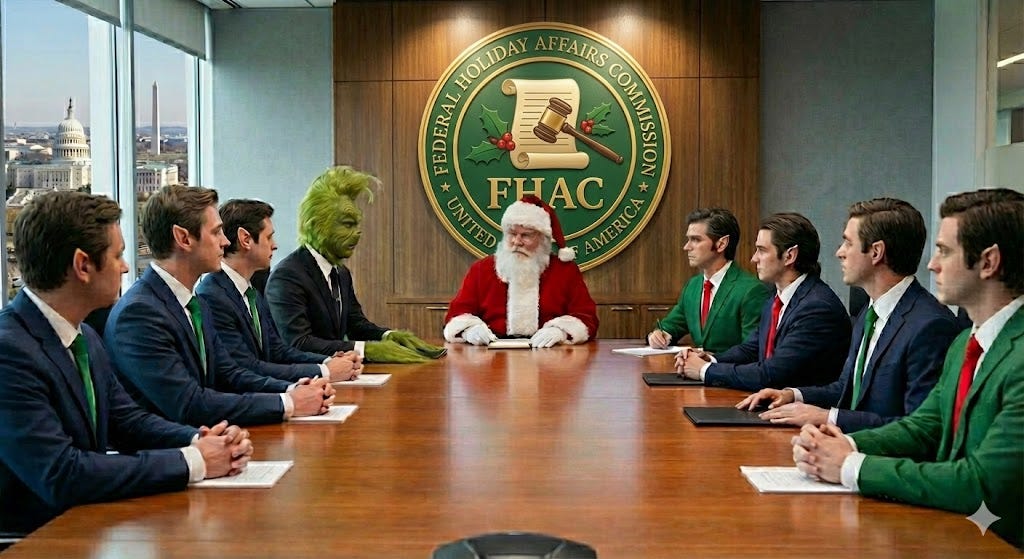
Hope you’re having a happy holiday season!
Santa is a Unitary Executive
The “Unitary Executive” is the theory that the President alone is supposed to be able to remove appointed executive branch officials “just because.” Anyone on a commission who has a policy disagreement with the President (or whom the President just does not like) is going to be dismissed. Get in line, or get a new job.
From a legal standpoint, the basis of the Unitary Executive comes from the President’s Article II duty to “take Care that the Laws be faithfully executed.” But as we all learned in 5th grade, the President does not make the laws she is charged with faithfully executing—that’s Congress’s Article I power “To make all Laws which shall be necessary and proper for carrying into Execution the foregoing Powers, and all other Powers vested by this Constitution in the Government of the United States, or in any Department or Officer thereof.”
One could easily see how the unitary executive theory would be attractive to our current President, who surrounds himself with sycophants and thinks he has a “very good brain.” But the theory was actually not developed to appease Trump’s ego. Rather, it’s part of a much more complex constitutional scheme that reflects progressive—and not conservative—governance. The bedwetting by the left about how the Supreme Court is handing Trump another victory in the case of Trump v. Slaughter needs to stop. In fact, the Supreme Court is paving the way for a government that is politically responsive rather than captured by regulated industries.
Governing in the modern age is complex. Our government is expected to make, among other things, rules about finance, nuclear energy, business competition, communication technology, and consumer product safety, etc. etc.. Those things require expertise—expertise that politicians don’t have and, in many cases, don’t want to have. So starting in the early part of the last century, Congress, in its wisdom and at the request of Executives who needed to figure out how to govern through a war and a depression, created a host of “independent administrative agencies” to deal with these issues. For finance it’s the Securities and Exchange Commission (“SEC”), for business competition it’s the Federal Trade Commission (“FTC”), for nuclear energy its the Nuclear Regulatory Commission (“NRC”), for communication technology it’s the Federal Communications Commission (“FCC”), and for consumer product safety it’s the Consumer Product Safety Commission (“CPSC”). There are more, but you get the idea.
These agencies pass laws (“regulations”), enforce those regulations, and penalize people who break the rules. The agencies basically take all three branches of the federal government and mush them together. Sometimes something good comes from the mush. But most of the time, nothing good comes of it. Why? The only people who master the rules of these agencies are the people and companies with business in front of them, and the lawyers they hire. There is a reason why every law firm in the nation has a Washington, D.C. office. The legal term is “regulatory capture.”
Regulated industries like this setup. So do politicians who can plead ignorance. After all, the rules are being made by “independent agencies.” If you don’t like it, don’t write to your Congressperson. Rather, hire a lawyer and submit a timely comment to the Federal Register during the “comment period.” I’ve done that for clients. It’s not something your average concerned citizen can do on their lunch break. And it’s not designed to be.
At this point, unwinding the administrative state is not really possible, or at least can’t be done quickly. So its opponents found two other ways to do it. I’ve written before about the first: undoing “administrative deference,” the idea that while Congress passes laws, the independent administrative agencies fill in the blanks and—when someone challenges an agency rule—the agency actually gets deference.

In two decisions last term, the Supreme Court did away with that deference, which means that judges, not administrative agencies, are making the ultimate interpretation of Congress’s ambiguous or poorly sketched-out law.
While this expands judicial power at the expense of the executive branch, it’s actually Congress that is ultimately responsible here. What the Supreme Court is really saying is that Congress needs to stop passing ambiguous laws and leaving it to someone else to sort out. Yes, you can (and should) write to your Congressperson if you feel strongly that something needs to be regulated differently or better. Congress—not the administrative agencies carrying out the laws—needs to be the one with the expertise. I actually think that makes sense. Its more transparent, responsive, and accountable.
But there is another way that opponents of the administrative state have been quietly chipping away at it. If you can control who sits on these commissions—who actually makes the day-to-day decisions inside the so-called “independent” agencies—you can do quite a lot. Combine that with the end of administrative deference and suddenly the structure that once insulated technocratic rulemaking from politics… isn’t so insulated anymore. Together, these two developments shift power back where the Constitution originally put it: with politically accountable actors.
And that is what the Supreme Court is actually doing. And this is good even though it feels like Trump is winning. He is not. Congress, if it ever gets its act together, should be restored to its place as the maker of “all laws.” Congress is the real winner.
And a President who is required to “take Care that the Laws be faithfully executed” cannot do that if vast swaths of the government answer to no one—except the entities they regulate. A progressive movement that wants the government to work should want a government that is accountable and efficent and united. Democrats need to stop defending the status-quo and start thinking about a new modle that can actually make government work better for those of us who depend on it. Which is to say everyone except the very rich and well connected.
In this holiday season, it’s important to remember that Santa is the ultimate unitary executive. Santa does not delegate his tasks to some independent commission. Kids write directly to him, and he alone answers for the result. Santa—with his purported ability to deliver hundreds of millions of gifts in a single night using nothing more than an old-fashioned sleigh and a few reindeer—is the ultimate unitary executive. He uses those powers for good and is radically accountable for them. That is a model we should all emulate.
The Grinch Stole Your Entertainment Job
Any objection to the sale of Warner Bros. Discovery to Netflix or Paramount on competition/antitrust grounds is bogus. The reality is that there is no competition issue. If Americans need to pay more for streaming highly produced content, so what? The free options – YouTube, social media, and whatever is next – are dynamic, socially relevant, and accessible for both creators and the audience. Also, there are healthier things to do than sit around and binge-watch “Is It Cake?”
If there is a reason to block the sale, it’s because of its effect on the creative class: when there is less produced content, it’s harder for creators to make money. In a different country, the effect of a merger on workers might be enough to block it. But not this one. Under the Biden administration, there was an effort to address the impact of mergers on the labor market. In theory, the same forces that lead to increased prices in a consolidated market could also decrease wages since there are fewer buyers for the services. There is no doubt that Netflix and Paramount are going to do everything they can to use fewer well-paid (and unionized) actors, stagehands, writers, and other creators, and those in the entertainment business have one less door to knock on. And, of course, the specter of AI haunts us all.
You can also be sure that Trump’s antitrust people don’t give a crap about wages for workers in the entertainment business. It does suck for those feeling the earth shift beneath their feet – as a self-employed lawyer, I feel for you on the job front – but it all works out (sometimes not how you expect). I can attest to that. I represent some influencers and creators, and, more often, the companies that hire them. The opportunities are there. You just need to be creative and have good counsel :). No pun intended.
A lot of the concern is actually not an antitrust issue. It’s about CNN, that decaying media property that very few people outside of Washington are watching. The concern is that Netflix does not care about news (it plans to spin off CNN), and that Paramount Global, which owns CBS, is going to own CNN (my understanding is that it plans to keep CNN) and therefore this combination is going to limit Americans’ access to quality news. Bogus, again.
Americans don’t get their news from cable or networks anymore. CNN has some good journalists doing important work, but so does Substack. And most Americans get their news from their Facebook and TikTok feeds. The real issue is keeping the financial spigot open for high-quality fact-based journalism. For the most part, corporate America abandoned that responsibility, and we need to accept that. We have a different, still evolving model. Whether that new model sustains the news we need to keep our democracy functioning is a separate question. But don’t think that corporate America, or the Trump administration, is going to help here. Quite the opposite. Only real demand can save the news business.
The most interesting legal questions surround the duty that WarnerBrother Discovery’s board has to their shareholders to take the highest deal – Paramount is offering $30 per share more than Netflix. You can bet there are some big firm lawyers working (and billing) through the night in anticipation of litigation. Happy holidays to them! So aside from all the fun that the Warner Bros. lawyers are having trying to figure out how to either win, or avoid, a major lawsuit, this transaction is not really worth watching (pun intended).
Keep thinking, keep building,
Jesse
Hi, and welcome to my newsletter! I’m Jesse Strauss, Your Fractional General Counsel. I’m a lawyer with a private practice based in New York City, helping clients in the United States and globally with their U.S. legal needs. My expertise spans various areas, including raising funding rounds, employment issues, negotiating master service agreements, intellectual property, compliance, legal process management, and dispute resolution. My focus is on founding and nurturing great companies from seed to exit. Discover more at Your Fractional GC and book a complimentary 30-minute consultation. You can also follow me on Threads @lawyerjesse1977, on BlueSky @lawyerjesse.bsky.social, subscribe to my Substack here (follow me on notes), and follow me on LinkedIn here.
Originally published at Fractionally Yours, Jesse's Substack.