I write this in the shadow of the capitulation of seven Democratic Senators who lent their votes (and perhaps their souls) to Trump to help him reopen his government. As of this writing, the Federal government has reopened. With the notable exception of the possible release of the Epstein files (which is far from assured), nothing good will come of reopening Trump’s government.
Yes, if the shutdown ends people will get their food benefits, and everyone’s relatives, for better or worse, will be able to fly on Thanksgiving. There is a promise to undo shutdown-era layoffs, and federal employees will be paid again. I suppose those are good things. And, of course, with the House of Representatives back in session there is a chance that, in a few weeks, they will vote to release the Epstein files, although the Senate needs to agree, and Trump too. So that story lives on.
While the government was closed because Congress stood fast to its enumerated appropriation powers (more on that later), Trump could not really operate his government – all he could do was fire federal workers and stop public benefits (illegally) – which was part of the agenda all along. There is a reason why the only non-shutdown-related bad policy out of Washington for the last few weeks was the destruction of the East Wing, with a smattering of foreign affairs (faux peace in the Middle East, for example) and blowing up boats in the Caribbean. Unpaid federal workers did not have to sell off federal lands to fossil fuel producers, think of new ways ICE can persecute undocumented workers, privatize veterans’ care, and whatever perversions this administration can think of. Personally, I would have rather kept it that way for as long as possible.
The government funding is temporary. The spending bill only lasts through mid-January. To think the capitulating Democrats “won” anything you need to believe that Trump and his sycophants were craven enough to deny food and energy benefits, fire people, and keep grandma grounded during the Holiday season. Juxtaposed against the images of Trump’s people at their gilded holiday parties, the sheer cruelness of that would mainstream what the partisans already know: Trump does not care about 99% of Americans. In my opinion the clock was on the Democrats’ side, and the Democrats’ capitulation was an example of bedwetting, pure and simple.
Side note: I almost wet the bed on the eve of my first trial when I asked for a settlement offer from the defendant’s counsel and, sensing weakness, he came back with almost nothing. That discussion, in the judge’s chambers on the eve of trial, is one of my flashbulb memories. We went to trial and won a judgment with $2.5 million for the clients, who were unpaid vendors. The other lawyer got sued for malpractice. True story and an example of why you should never act from a position of perceived weakness.
Trump and his sycophants have a total disregard for the role of Congress and the Courts. The shutdown was about asserting that Congress matters. And that is important as we watch our small-d democratic institutions buckle.
Constitutionally, although all the branches are co-equal, Congress is Article I, the executive is Article II, and courts are Article III. Congress’s powers are “enumerated” in Article I, Section 8 and the first among those enumerated powers is to “lay and collect Taxes, Duties, Imposts and Excises, to pay the Debts and provide for the common Defence and general Welfare of the United States” and “make all Laws which shall be necessary and proper for carrying into Execution the foregoing Powers, and all other Powers vested by this Constitution in the Government of the United States, or in any Department or Officer thereof.” Anything not “enumerated” is “reserved” to the States per the 10th Amendment.
Republicans in Congress have ceded all their enumerated powers to Trump. But there is (or was) an opposition party that had some limited powers. As a dad to a 9-year-old, I see lots of Spider-Man movies. Everyone knows Spider-Man’s mantra: with great power comes great responsibility. But the inverse is not true: having limited power does not mean you have limited responsibility. When your power is limited, use it responsibly. For every powerful “winner” in history, there were losers who squandered what little power they may have had to resist. While our battle to preserve our rule of law and constitutional system with co-equal branches of government that has served us so well since 1789 is not over, this latest skirmish is not encouraging. At least with respect to the Congress. Again, this is not about the ACA subsidies or flight schedules. It’s about Congress’s enumerated powers and how easily they were ceded.
In contrast to Congress, the President’s powers are much more limited. Other than foreign policy and appointments, where the Executive has very broad powers, the constitutional scheme only requires the President to “take Care that the Laws be faithfully executed.” Those laws are passed by Congress. In fact, the recent cases of Loper Bright Enterprises v. Raimondo, SEC v. Jarkesy, and Corner Post, Inc. v. Board of Governors of the Federal Reserve System, which I wrote about

are actually cases that limit executive power by eliminating executive “agency deference” in favor of the wording of the laws Congress passes. Those decisions were seen as losses for the Biden Administration. In fact, they were wins for Congress’s supremacy.
As for the Courts, it was the understanding of the founders that the States (and their courts and constitutions) were actually the guardians of the people’s rights, so the idea of a Supreme Court and a federal judiciary was relegated to third position. Federal judicial power was (and remains) “limited.” There are specific things that Federal Courts have power to hear, and if not on the list, see you in State court.
Federal courts’ power extends to “all Cases, in Law and Equity, arising under this Constitution, the Laws of the United States,” so cases regarding federal laws, like whether to pay food benefits or cases where someone is accused of breaking a federal law by, say, attacking a federal offical, are decided by federal courts. Federal judicial power is also limited in a very important and underappreciated way. When it comes to criminal law, the Constitution, Article III, Section 2, is very specific that “The Trial of all Crimes, except in Cases of Impeachment, shall be by Jury; and such Trial shall be held in the State where the said Crimes shall have been committed.” That assurance that the federal government can’t prosecute defendants away from their home community, and that the fact finder is a jury constituted from that community (at least on a state level), is important, and I will return to it later.
So what about the Courts – those constitutional stepchildren? How are they holding up? Actually, pretty well. I’ll grant that the Supreme Court has a mixed record by, for example, allowing Trump to fire federal workers and giving him immunity, although we don’t really know because the big cases, like the birthright citizenship case, have yet to be decided. So if the Courts won’t cede their powers, what are Trump’s options? For one, he could outright ignore them. I think that is a very real possibility, but as I’ve written about before, it’s very risky for those officials who actually ignore the order because when a federal employee violates their oath to uphold the Constitution – like obeying a court order – they are, in theory, violating the law. They are, therefore, taking a gamble that the government will be overthrown and no one will ever hold them accountable. That is a big risk.
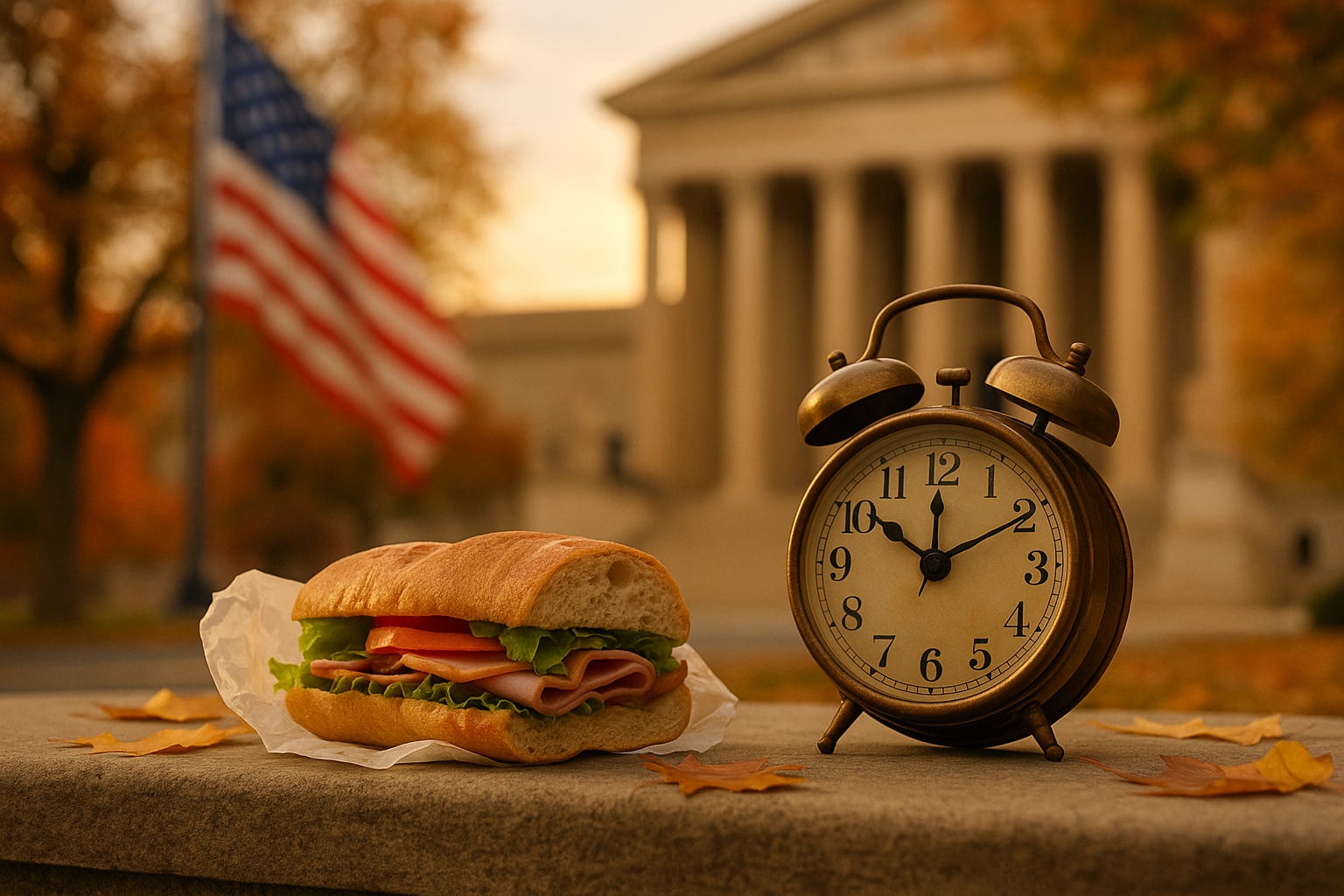
Another way to deal with pesky courts is to close them. That sounds like a stretch, but it’s probably more realistic than not. When Trump ordered the National Guard and federal law enforcement to surge into D.C. this summer (something that was not possible during the government shutdown, mind you, because the folks responsible for planning those operations were specifically prohibited from doing so) one man, Sean Dunn, got so angry he threw his sandwich at a U.S. Customs and Border Protection officer. The government arrested him and made a special point of prosecuting him for “assault” and interfering with law enforcement – basically the government’s way of saying that if you are troubled by troops patrolling the streets of American cities, keep it to yourself. For at least the past 5 weeks, those prosecutors whose job it was to lock up Dunn for his dissent were unpaid (see above). Last week a jury in the District of Columbia found Dunn innocent. Per Article III, because the crime of throwing the sandwich at a federal agent occurred in the District of Columbia, the trial had to happen there too. The jury decided that Dunn, like them, was frustrated to see a huge and unnecessary law enforcement presence. And the act of throwing the sandwich in frustration was not criminal.
If the Constitution did not forbid it, Dunn’s trial would have happened in a place like Texas, where the jury probably would have convicted him. But moving the case like that would be unconstitutional. So would trying it without a jury. So perhaps the better option would be to just close the courts, completely. If that happened, then martial law could be declared.
Sandwich throwers, and anyone else disfavored (me? you?), would find themselves, as I wrote in June, “in front of a military tribunal, not civilian courts, held in military prison.”
Can Trump close the courts in the District of Columbia and declare martial law? Yes. Will he? Maybe. Actually, he likely will if the opportunity presents itself. We know that is how authoritarians work. Hitler accused Communists of burning the Reichstag, and passed the Reichstag Fire Decree which basically eliminated the German Constitution. Trump will do the same. The Capitol Building won’t burn, but there are many ways to skin a cat. Maybe one too many sandwiches will be thrown at federal agents.
In the event of a wide-scale civil disturbance, our federal system makes it likely that martial law would be state-to-state (some states will shut their courts, others will not). But many places in America will be under martial law, and those that are not will be protesting and Trump will try to declare martial law in those places as federal property is destroyed. But state courts will likely remain open but really hard to access. The question whether Trump can declare martial law will be squarely presented to whatever courts remain open. At that point we will see whether the Supreme Court will follow the lead of the seven senators who forfeited what little power they had. The clock is ticking.
Keep thinking, keep building,
Jesse
Hi, and welcome to my newsletter! I’m Jesse Strauss, Your Fractional General Counsel. I’m a lawyer with a private practice based in New York City, helping clients in the United States and globally with their U.S. legal needs. My expertise spans various areas, including raising funding rounds, employment issues, negotiating master service agreements, intellectual property, compliance, legal process management, and dispute resolution. My focus is on founding and nurturing great companies from seed to exit. Discover more at Your Fractional GC and book a complimentary 30-minute consultation. You can also follow me on Threads @lawyerjesse1977, on BlueSky @lawyerjesse.bsky.social, subscribe to my Substack here (follow me on notes), and follow me on LinkedIn here.
Originally published at Fractionally Yours, Jesse's Substack.